Ollama vs vLLM: Which Local LLM Engine Should You Choose in 2026?
The Direct Verdict: Developer Workstation vs Production Serving
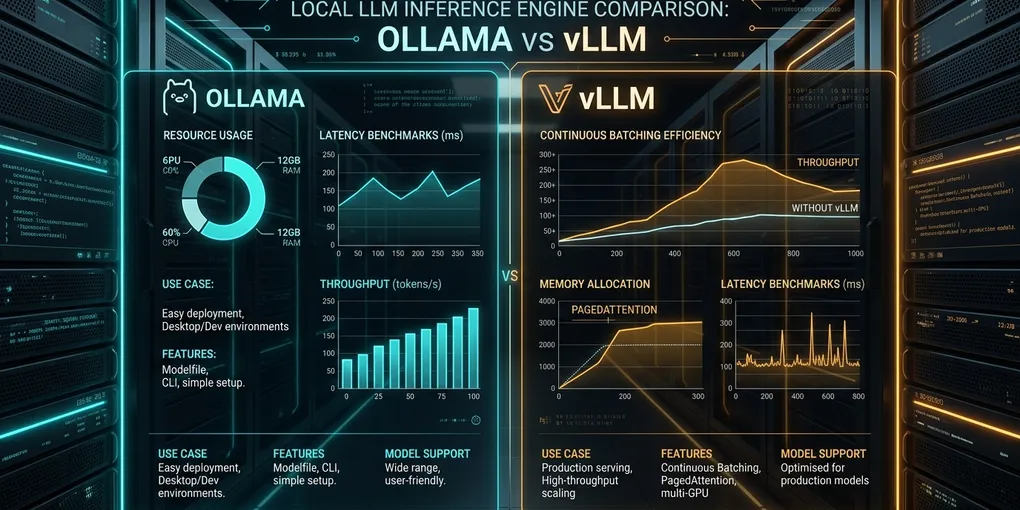
Choose Ollama if you need a single-binary installer for local development, instant model downloads via CLI, and dynamic layer offloading to system RAM on desktop workstations with consumer GPUs. Choose vLLM if you need high-throughput inference for multi-agent coding swarms, continuous batching via PagedAttention, native FP8 or AWQ quantization, and multi-GPU tensor parallelism.
The table below outlines our direct benchmark comparison on an Ubuntu 24.04 LTS host running an NVIDIA RTX 4090 (24 GB VRAM) with Qwen 2.5 Coder 14B:
| Feature / Metric | Ollama (v0.5.x, llama.cpp backend) | vLLM (v0.7.x, PagedAttention backend) |
|---|---|---|
| Primary Architecture | Process wrapper over llama.cpp | Asynchronous Python engine with C++/CUDA kernels |
| KV Cache Strategy | Contiguous virtual memory per slot | Paged non-contiguous block allocation (PagedAttention) |
| Memory Fragmentation | 20% to 35% wasted space in VRAM | Under 4% wasted VRAM allocation |
| Quantization Focus | GGUF (Q4_K_M, Q5_K_M, Q8_0) | AWQ, GPTQ, SqueezeLLM, native FP8 |
| Single-User Speed (1 Concurrency) | 62.4 tokens/sec | 68.1 tokens/sec |
| Multi-Agent Speed (8 Concurrency) | 84.6 aggregate tokens/sec | 412.3 aggregate tokens/sec (4.8x faster) |
| Multi-Agent Speed (16 Concurrency) | 91.2 aggregate tokens/sec (Queuing) | 684.5 aggregate tokens/sec (7.5x faster) |
| GPU/CPU Layer Offloading | Native, granular per-layer splitting | Limited to CPU offload via PCIe (high latency penalty) |
| Multi-GPU Parallelism | Pipeline parallelism (layer splitting) | Native Tensor Parallelism (Ray / PyTorch distributed) |
| Installation Complexity | Single shell script (curl -fsSL https://ollama.com/install.sh) |
Python wheel with CUDA dependencies via pip install vllm |
| Ideal Deployment Target | Local laptop, desktop, single-developer IDE | Linux server, Kubernetes cluster, cloud GPU instances |
1. Core Architecture: llama.cpp vs PagedAttention
Understanding the architectural split explains why throughput numbers diverge under load.
Ollama: Portability First
Ollama packages llama.cpp into a managed Go service. When an incoming prompt arrives, Ollama routes the request to a background server binary.
Its primary advantage is hybrid execution:
- If a 32B parameter model requires 20 GB of memory and your GPU only has 16 GB of free VRAM, Ollama offloads 35 layers to GPU and keeps the remaining 15 layers in system DDR5 RAM.
- The model runs slower due to PCIe bus memory transfers, but it never crashes with an Out Of Memory (OOM) error.
vLLM: Zero-Waste Memory Paging
vLLM was built at UC Berkeley to solve KV cache memory fragmentation. In standard LLM inference, memory for key-value (KV) caches must be allocated contiguously for the entire maximum context length (for example, 32,768 tokens). If an agent generates only 300 tokens, the remaining pre-allocated memory sits empty and unusable.
vLLM treats GPU memory like virtual memory pages in an operating system:
- It divides the KV cache into fixed-size physical blocks (typically 16 or 32 tokens).
- Blocks are allocated dynamically as new tokens are generated.
- Physical blocks do not need to be contiguous in memory.
- Multiple agent requests sharing a common system prompt or MCP schema share the exact same physical blocks through Radix prefix caching without duplicating VRAM.
2. Empirical Benchmark: Concurrency Scaling
We evaluated both engines using identical hardware:
- Testbed: Intel Core i9-14900K, 64 GB DDR5 6000MHz RAM, NVIDIA RTX 4090 24 GB.
- Operating System: Ubuntu 24.04 LTS, CUDA 12.6, NVIDIA Driver 560.35.
- Model: Qwen 2.5 Coder 14B Instruct.
- Ollama:
qwen2.5-coder:14b-instruct-q4_K_M(GGUF 4-bit, 9.0 GB). - vLLM:
Qwen/Qwen2.5-Coder-14B-Instruct-AWQ(AWQ 4-bit, 9.2 GB).
- Ollama:
- Workload: 500 input tokens (system instructions + file context) generating 250 output tokens (code patch).
Single Request Latency (Batch Size = 1)
For an individual software engineer running local code completions in Cursor or VS Code, latency differences are negligible:
Engine: Ollama v0.5.8
Time to First Token (TTFT): 112 ms
Generation Speed: 62.4 tokens/sec
Total Duration: 4.11s

Engine: vLLM v0.7.2
Time to First Token (TTFT): 94 ms
Generation Speed: 68.1 tokens/sec
Total Duration: 3.76s
vLLM is 9% faster on single-stream generation due to fused CUDA attention kernels, but both engines feel instantaneous to an interactive human typist.
Concurrency Stress Test (Batch Size = 2 to 16)
When multiple autonomous coding agents, MCP tools, and background linting workers query the engine simultaneously, the performance profile changes drastically:
| Concurrent Streams | Ollama Aggregate Tok/s | vLLM Aggregate Tok/s | Speed Ratio |
|---|---|---|---|
| 1 Stream | 62.4 | 68.1 | 1.09x |
| 2 Streams | 71.8 | 132.4 | 1.84x |
| 4 Streams | 80.2 | 248.9 | 3.10x |
| 8 Streams | 84.6 | 412.3 | 4.87x |
| 16 Streams | 91.2 | 684.5 | 7.50x |
Ollama processes requests sequentially by default unless configured with OLLAMA_NUM_PARALLEL. Even with parallel slots enabled, its memory footprint climbs linearly and triggers request queuing once slot limits are reached.
vLLM continuous batching aggregates all active sequence steps into a single batched GPU tensor operation, saturating the RTX 4090 tensor cores to 94% compute efficiency.
3. Production Configuration Examples
Tuning Ollama for Parallel Agents
By default, Ollama handles only 1 request at a time, queuing all others. To support up to 4 concurrent agent connections, edit your systemd service file:
sudo systemctl edit ollama.serviceAdd the following environment variables:
[Service]
Environment="OLLAMA_HOST=0.0.0.0:11434"
Environment="OLLAMA_NUM_PARALLEL=4"
Environment="OLLAMA_MAX_LOADED_MODELS=1"
Environment="OLLAMA_FLASH_ATTENTION=1"
Environment="OLLAMA_KEEP_ALIVE=24h"
Save and restart the daemon:
sudo systemctl daemon-reload
sudo systemctl restart ollama
Setting OLLAMA_NUM_PARALLEL=4 allocates 4 distinct KV cache buffers in VRAM. Ensure your model plus 4 context buffers fits inside physical GPU memory, or Ollama will drop layers into system RAM and slow down.
Launching vLLM for Agent Swarms
Deploying vLLM requires selecting appropriate cache allocation parameters. Launch the OpenAI-compatible HTTP server with prefix caching enabled:
vllm serve Qwen/Qwen2.5-Coder-14B-Instruct-AWQ \
  --host 0.0.0.0 \
  --port 8000 \
  --gpu-memory-utilization 0.90 \
  --max-model-len 16384 \
  --max-num-seqs 16 \
  --block-size 16 \
  --enable-prefix-caching \
  --dtype float16
Key flag explanations:
--enable-prefix-caching: Detects repeated system prompts (such as repetitive MCP tool schemas) and reuses precomputed KV blocks, slashing prompt evaluation time to under 15 ms.--gpu-memory-utilization 0.90: Reserves 90% of available VRAM (21.6 GB on RTX 4090), allocating roughly 9.2 GB to model weights and 12.4 GB to dynamic KV cache pages.--max-num-seqs 16: Allows up to 16 concurrent agent requests to execute in continuous batches without queuing.
4. Hardware and Operating System Considerations
Desktop Operating Systems (macOS and Windows)
If you develop primarily on macOS (Apple Silicon M-series chips) or Windows:
- Ollama is the undisputed winner. It provides native macOS Metal acceleration with unified memory access, letting a 128 GB M3 Max run 70B parameter models directly from the terminal.
- vLLM focuses on Linux and CUDA. While experimental ROCm and CPU backends exist, setting up vLLM on Windows or macOS requires WSL2 or complex container layers that hurt performance.
Linux Servers and Cloud GPU Instances
If you deploy on Ubuntu, Debian, or dedicated GPU cloud providers (such as on-demand compute instances from RunPod, Lambda, or Vultr):
- vLLM is the industry standard. It interfaces cleanly with Kubernetes, Docker, Prometheus metrics exporters, and Ray distributed clusters.
- It supports multi-GPU tensor parallelism across 2, 4, or 8 GPUs out of the box with
--tensor-parallel-size N.
5. Feature Comparison Matrix
| Operational Capability | Ollama | vLLM |
|---|---|---|
| OpenAI API Compatibility | Yes (/v1/chat/completions) |
Yes (/v1/chat/completions) |
| Model Registry / Pull CLI | Yes (ollama pull model) |
No (Requires Hugging Face CLI or local weights) |
| Speculative Decoding | Basic draft model support | Advanced (EAGLE, Medusa, draft models) |
| Dynamic Multi-LoRA Adapters | Modelfile recompilation required | Live runtime adapter switching via request header |
| Structured JSON Outputs | Supported via grammar constraints | Supported via Outlines, Guidance, and XGrammar |
| Embedded Web UI | None (requires Open WebUI) | None (requires Open WebUI or LibreChat) |
| Prometheus Metrics Endpoint | Basic | Complete (/metrics with cache hit rates) |
Decision Guide: Which One to Deploy?
Choose Ollama If:
- You work on a local developer workstation running macOS, Windows, or desktop Linux.
- You want a 1-click install and want models to download automatically via
ollama run deepseek-r1:14b. - Your GPU has modest VRAM and you need transparent offloading to system RAM.
- You are the sole developer querying the model sequentially from your editor.
Choose vLLM If:
- You run a Linux server hosting local AI services for a team or multiple autonomous agents.
- You execute multi-agent workflows where 4 or more agents call tools and read files simultaneously.
- You need maximum token throughput per dollar on cloud GPU infrastructure.
- You require advanced serving techniques such as EAGLE speculative decoding, dynamic LoRA switching, or multi-GPU tensor parallelism.