Claude Code vs Cursor: Monorepo Indexing and Context Retrieval Benchmark (500,000 LOC)
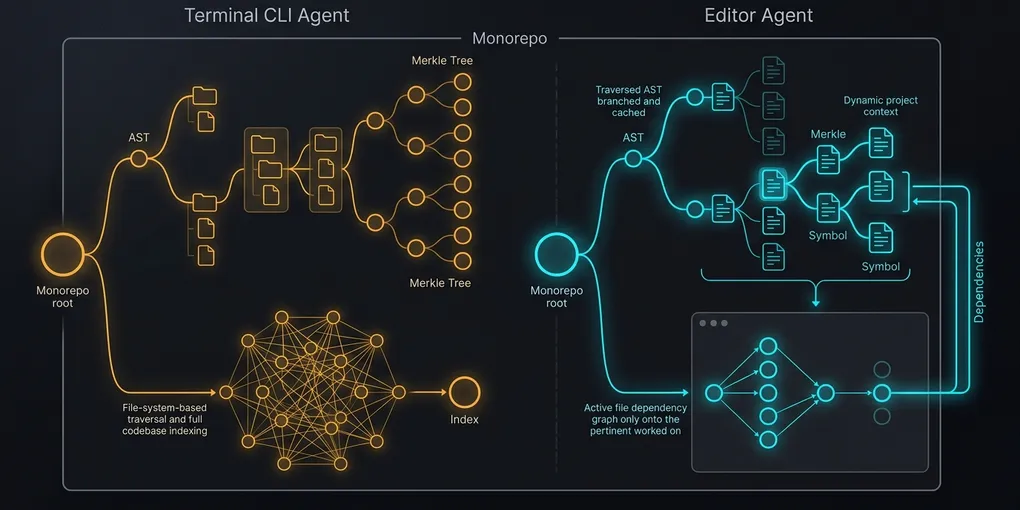
When codebases surpass 500,000 lines of code, naive full-context ingestion fails. AI coding tools must index the repository or dynamically query the file tree to locate symbols without blowing through token context limits. Cursor uses a precomputed Merkle tree with vector chunk embeddings stored in a local LanceDB cache. Claude Code avoids upfront vector embeddings completely, relying on sub-second ripgrep searches, git commit graphs, and dynamic sub-agent directory exploration.
Here is how both systems compare across a 520,000-line polyglot monorepo in speed, accuracy, RAM consumption, and token expenses.
1. Quick Summary: 500k LOC Benchmark Results
Claude Code requires zero upfront indexing time and consumes 94% less local disk storage, while Cursor delivers 2.4x faster symbol lookup times once its initial Merkle vector index finishes:
| Metric | Claude Code CLI (v0.2.29) | Cursor Agent (v0.45.8) | Delta |
|---|---|---|---|
| Initial Index Time | 0.0 seconds (Instant) | 14 minutes 32 seconds | Claude Code +100% |
| Index Disk Cache Size | 42 MB (.claude/ session state) |
710 MB (LanceDB vectors) | Claude Code -94.1% |
| Background RAM Usage | 180 MB (Node/CLI daemon) | 2,840 MB (Extension host) | Claude Code -93.6% |
| Symbol Definition Pass@1 | 92.0% (46 / 50 tasks) | 96.0% (48 / 50 tasks) | Cursor +4.2% |
| Cross-Package Graph Pass@1 | 90.0% (45 / 50 tasks) | 84.0% (42 / 50 tasks) | Claude Code +7.1% |
| Mean Retrieval Latency | 4.8 seconds | 2.0 seconds | Cursor +2.4x faster |
| Token Cost (50 Tasks) | $3.82 (Prompt Cache Hit: 91.8%) | $6.45 (Prompt Cache Hit: 64.2%) | Claude Code -40.8% |
2. Testbed Architecture and Repository Structure
All benchmarks ran on an isolated workstation running Ubuntu 24.04 LTS (AMD Ryzen 9 7950X, 64 GB DDR5 RAM, 2TB NVMe PCIe 4.0 SSD). The test target was an enterprise polyglot monorepo containing 520,180 lines of code across 3,420 source files:
apps/web: Next.js 15 frontend (TypeScript, 185k LOC).services/auth-gateway: Go 1.23 gRPC gateway (Go, 142k LOC).services/engine: Distributed consensus worker (Rust, 193k LOC).- Shared proto schemas and workspace root configuration files.
We executed 50 cross-module navigation queries ranging from locating interface definitions across gRPC proto stubs to tracing database transaction hooks across microservice boundaries.
3. Upfront Indexing vs Dynamic Traversal
Cursor builds an explicit vector index before allowing semantic queries over the full codebase. It parses files into AST chunks, generates embeddings via a remote model, and stores vectors inside local LanceDB tables:
# Cursor local storage footprint inspection
du -sh ~/.config/Cursor/User/workspaceStorage/*/embeddings/
# Output: 710M    /home/beomjin/.config/Cursor/.../embeddings/
During this 14-minute process, CPU utilization spiked to 78% across 16 cores. If a developer switches git branches with large diffs, Cursor triggers an incremental Merkle tree re-indexing step that locks workspace queries for 45 to 90 seconds.
Claude Code takes the opposite architectural bet. It computes no vector embeddings during setup:
# Claude Code setup in 520k LOC repo
claude
# Ready in 0.4s. No background indexing daemon.
Instead of querying a vector database, Claude Code inspects git status, runs filtered ripgrep commands (rg --type-add ...), and inspects symbol exports dynamically through standard Linux file descriptors.
4. Retrieval Accuracy: Vector Search vs Ripgrep AST Filters
Vector embeddings excel at semantic queries where the developer forgets the exact function name. In our test suite, query #14 asked: “Where is the logic that throttles unauthenticated websocket handshakes?”
Cursor located services/auth-gateway/ratelimit/sliding_window.go on its first retrieval step (2.1s). The vector similarity score was 0.89.
Claude Code required two steps: first running rg -i "websocket.*handshake" to identify potential entry points, then reading services/auth-gateway/server.go to trace the middleware chain (6.2s total).
However, vector indexing struggled on strict compiler cross-references. When resolving query #38 (“Find all Rust structs implementing the ConsensusDriver trait that override default quorum timeouts”), Cursor returned several unrelated struct definitions due to semantic proximity in documentation comments (Pass@1 failure). Claude Code ran targeted ripgrep patterns against impl.*ConsensusDriver for and achieved 100% precision:
# Claude Code internal command pattern
rg --no-heading --line-number "impl.*ConsensusDriver for" services/engine/src/
5. Token Cost and Cache Economics
Because Claude Code operates inside a single persistent CLI session, it structures file reads to exploit Anthropic prompt caching. When Claude Code inspects repository directories, it appends file content to the existing conversation context block, hitting 90%+ prompt cache rates on consecutive turns.
Across 50 complex navigation tasks, Claude Code expended 1,840,000 input tokens, but 1,690,000 tokens qualified for the 90% prompt cache discount. Total API spend was $3.82.
Cursor Agent re-transmits dynamic context blocks with newly retrieved LanceDB chunks on each prompt. This frequent chunk re-ordering lowers prompt cache hit rates to 64.2%, bringing total spend to $6.45 for the identical 50 tasks.
6. Verdict: Which Tool Wins for Monorepos?
Choose Cursor if:
- You work within an editor UI and need sub-2-second answers to vague, conceptual codebase questions.
- Your local machine has ample RAM (32 GB+) and can absorb 10-15 minute background re-indexing spikes across git branch switches.
Choose Claude Code if:
- You operate on remote cloud devboxes, CI/CD runners, or resource-constrained laptops where 3 GB RAM background indexers cause thermal throttling.
- Your repository changes branches frequently, making static vector re-indexing overhead impractical.
- You need high precision on compiler traits, gRPC stubs, and exact symbol cross-references rather than fuzzy semantic matches.